



What if building wealth had less to do with being a genius and more to do with learning from others, avoiding major mistakes, and having the patience to wait?
Investor Mohnish Pabrai built his investment philosophy around ideas inspired by Warren Buffett, Charlie Munger, and other successful thinkers. Rather than trying to predict every market move, he focuses on learning from proven examples, understanding risk, and recognizing opportunities when they appear.
His philosophy offers seven valuable lessons for anyone trying to build wealth.
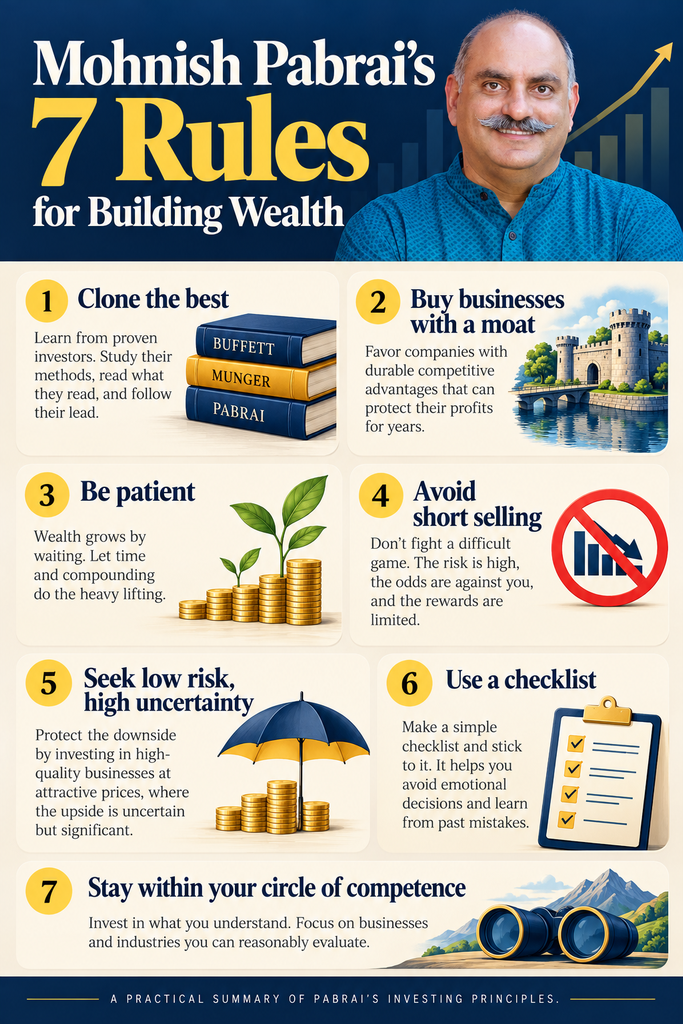
1. Copy What Already Works
Pabrai is known for describing himself as a “shameless cloner.” Instead of believing every successful person must invent a completely new strategy, he studies what has worked for others and adapts those lessons.
In investing, that means examining how experienced investors evaluate businesses, think about risk, and decide when to buy. You can apply the same principle to building a business, developing a career, or managing your money.
Imagine you want to start an online business. You could spend months guessing what customers want, or study businesses already succeeding in your market. Look at their pricing, products, marketing, and customer experience. Then identify what you can improve or adapt.
Copying does not mean blindly following someone else. Their circumstances, resources, and timing may be different from yours. The goal is to learn from proven methods rather than repeatedly making mistakes others have already solved.
The lesson: You don’t need to invent the path. Study what works, understand why it works, and adapt it intelligently.
2. Keep Your Strategy Simple
Pabrai’s approach draws heavily on the investment philosophy of Charlie Munger and Warren Buffett: focus on understandable businesses and avoid unnecessary complexity.
A complicated investment can sound impressive while hiding risks you have not properly evaluated. Before buying a company, ask simple questions. What does it sell? Why do customers buy from it? How does it make money? What could cause the business to struggle?
If you cannot answer these questions, you may not understand the investment well enough.
The same applies to personal finance. You do not necessarily need a complicated trading system, dozens of financial products, or constant portfolio changes. A straightforward plan that you understand and follow can be more useful than an elaborate strategy you abandon when markets become volatile.
Simplicity does not mean ignoring details. It means concentrating on the details that matter most.
The lesson: If you cannot explain why an investment makes sense in plain language, slow down before risking your money.
3. Wait for Exceptional Opportunities
The stock market offers something to buy almost every day. That does not mean something is worth buying every day.
Pabrai emphasizes patience and the importance of finding attractive opportunities where the potential reward justifies the risk. Instead of buying a stock simply because it is popular, investors should examine the underlying business, its prospects, and the price they are paying.
Imagine two companies. One is receiving plenty of attention but trades at a price that assumes years of extraordinary growth. Another is an understandable business that investors have overlooked, potentially leaving its shares undervalued.
The second company deserves investigation—but it is not automatically a better investment. You still need to determine whether its business is healthy and why the market might be mispricing it.
Waiting can be uncomfortable. You might watch other stocks rise while your money sits in cash. But chasing every rally can lead you to buy at unattractive prices.
The lesson: You do not have to participate in every opportunity. Sometimes your advantage comes from being willing to wait.
4. Protect Yourself From Big Losses
One of the central ideas behind Pabrai’s Dhandho investment philosophy is to seek situations where the potential upside is substantial relative to the downside.
The memorable principle is often expressed as “Heads I win; tails I don’t lose much.” It captures the idea of looking for favorable risk-reward situations—not a promise that losses can always be avoided.
Consider a $10,000 investment that falls 50%. You are left with $5,000, which requires a 100% gain just to return to your starting point.
That is why investors should ask what could go wrong before focusing on how much they might earn. Could debt threaten the company? Is the business losing customers? Are you paying a price that leaves no room for disappointment?
For individual investors, sensible position sizes, diversification, and maintaining emergency savings can help prevent one mistake from damaging the entire financial plan.
The lesson: Don’t just ask how much you could make. Ask how much you could lose—and whether you could recover.
5. Develop Deep Knowledge in a Narrow Area
You cannot understand every company, industry, and market equally well. Trying to follow everything may leave you with plenty of information but little genuine expertise.
Instead, develop what investors often call a circle of competence: a range of businesses you can evaluate with reasonable confidence.
Someone who understands retail, for example, may be better equipped to evaluate a retailer’s business model than a complex biotechnology company. That does not make retail automatically safer. It simply gives the investor a stronger foundation for asking useful questions.
Build knowledge by reading company reports, studying competitors, examining customer behavior, and learning how a business performs during difficult economic conditions.
Equally important, recognize the limits of your understanding. Knowing when to say “I don’t know enough about this” can save you from expensive mistakes.
The lesson: You don’t need to know everything. You need to know what you understand—and what you don’t.
6. Treat Stocks as Businesses, Not Lottery Tickets
A stock can rise or fall dramatically in a single day. That movement can make investing feel like a game of prediction, especially when social media is full of stories about overnight fortunes.
But buying a stock means purchasing an ownership interest in a business. Over time, the company’s earnings, cash flow, competitive position, and management decisions all matter to its underlying value.
A popular stock can still be a poor investment if you pay too much. An unpopular stock can also be a terrible investment if the business is deteriorating.
Rather than asking only whether a stock might jump next week, consider what the business could be worth several years from now and what evidence supports that estimate.
This approach does not eliminate uncertainty. Even careful investors get their analysis wrong. It simply gives you a more rational basis for making decisions than excitement, rumors, or fear of missing out.
The lesson: Before buying a stock, understand the business you are buying and why its future could justify the price.
7. Judge Yourself by Your Own Standards
Warren Buffett popularized the concept of an inner scorecard: measuring yourself by your own standards instead of relying on outside approval. It fits naturally with Pabrai’s emphasis on learning from successful people without becoming distracted by comparisons.
It is easy to measure financial success by someone else’s house, income, portfolio, or social media posts. But those comparisons tell you little about whether your own decisions are moving you toward financial security.
You might see someone make a fortune on a speculative stock and feel tempted to copy them. What you cannot see is how much they risked, whether they can afford a loss, or how many unsuccessful bets came before that win.
Define success around your own goals: paying off debt, building savings, investing consistently, creating a business, or gaining more control over your time.
The lesson: A sound financial plan should serve your life—not your need to impress other people.
The Smarter Take
Building wealth rarely depends on one brilliant decision. It is more often the result of many decisions made well over time: learning from proven examples, understanding what you own, avoiding catastrophic losses, and patiently waiting for opportunities.
Pabrai’s philosophy is not a shortcut to guaranteed riches. It is a framework for thinking more carefully about money, risk, and decisions. The goal is not to predict everything correctly. It is to build a process that helps you make better choices over time.